Laser Hair Removal: Everything You Should Know Before You Start
A complete guide to laser hair removal: how it works, how many sessions you need, which areas can be treated and whether it really hurts. Dr. Alejandra Téllez, Bogotá.
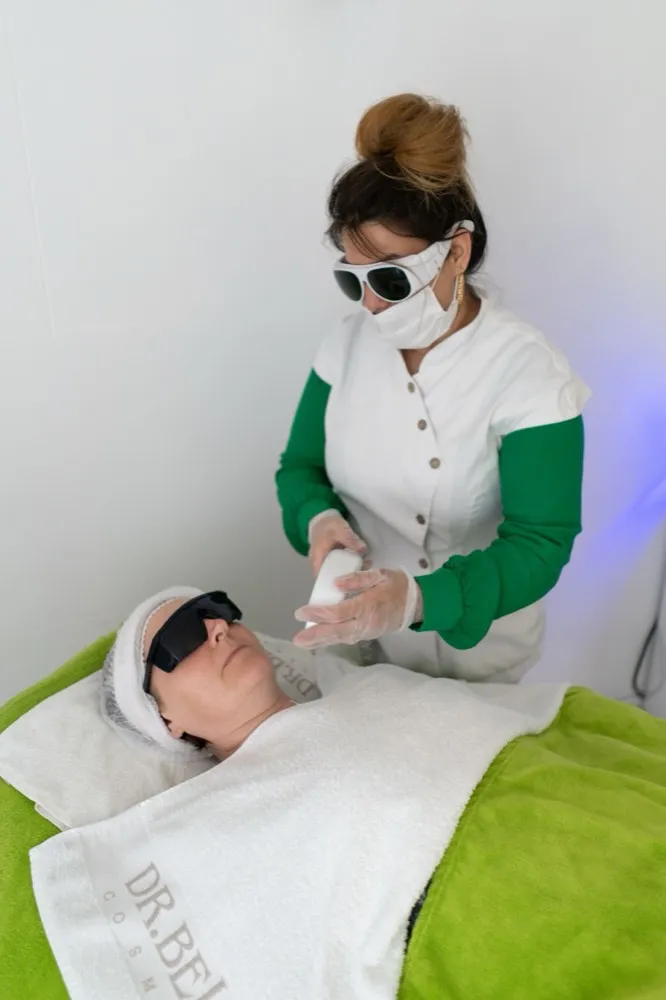
Laser hair removal is one of the most commonly performed aesthetic procedures in the world. Yet it still raises a lot of questions: Is it really permanent? Does it hurt? Does it work on darker skin? How many sessions are needed? Here I answer the questions I'm asked most often in my office.
How does the laser work?
The laser emits a beam of light that is selectively absorbed by the melanin in the hair follicle. The heat generated destroys the hair bulb without damaging the surrounding skin — this is called selective photothermolysis. For the treatment to be effective, the hair must be in its active growth phase (anagen).
The catch is that not all hairs are in the anagen phase at the same time: only 15% to 20% of the hairs in a given area are active at any one moment. That's why several sessions are needed: each one treats the hairs that were active at that time.
How many sessions are needed?
The number varies by area, hair type and skin phototype. In general:
| Area | Average sessions | |------|-------------------| | Underarms | 6–8 | | Bikini | 6–8 | | Legs | 8–10 | | Face (upper lip, chin) | 8–12 | | Back | 8–10 | | Arms | 6–8 |
After the initial cycle, maintenance sessions may be needed once or twice a year, especially in hormonally influenced areas (face, bikini).
Does it work on darker skin?
Latin American skin has particular characteristics that must be taken into account. Higher phototypes (darker skin) have more melanin in the skin — not just in the hair — which increases the risk of energy being absorbed by the epidermis and possible side effects such as hyperpigmentation or hypopigmentation.
The good news: modern long-wavelength lasers (Nd:YAG 1064 nm) are specifically designed to treat darker skin safely. The key is using the right laser with the right settings, not avoiding treatment.
Does it hurt?
It feels like a small "snap" or "sting" with each pulse. Modern devices include cooling systems that significantly reduce discomfort. Most of my patients describe it as tolerable — more uncomfortable in areas with thinner skin (bikini, face) and practically painless on the legs.
For more sensitive people, a topical anesthetic cream can be applied before the session.
Preparing for your session
- Do not wax, tweeze or thread in the 4 weeks before: the follicle must be intact
- Shave the area 24–48 hours before the session
- Avoid intense sun exposure in the 4 weeks before and after
- Do not use self-tanners in the 2 weeks before
- Stop certain medications if you're taking them (check with your doctor): some antibiotics, topical retinoids and isotretinoin can make the skin photosensitive
Aftercare
- The skin may be red and feel warm for the first 24–48 hours (this is normal)
- Apply a soothing, moisturizing cream
- Use SPF 50+ daily for at least 4 weeks
- Avoid saunas, hot tubs and intense exercise for the first 48 hours
- Do not exfoliate the area for 1 week
Is it really permanent?
The correct term is "permanent hair reduction." The sessions complete treatment of the active follicles and the result lasts for years. However, hormonal factors can stimulate follicles that were "dormant" — especially on the face and bikini area. That's why occasional maintenance sessions are normal in these areas.
Who should NOT have laser hair removal?
- People with very tanned skin (it increases the risk of burns)
- Pregnant women
- People with medication-related photosensitivity (ask your doctor)
- Some active skin conditions in the area to be treated
Blond, red or white hair: does the laser work?
The laser needs melanin in the follicle to work. On very light hair (platinum blond, light red, white or gray), the laser has little or no effect. In these cases, the alternative is electrolysis.
Want to know whether you're a good candidate for laser hair removal and how many sessions you'd need? During the consultation we evaluate your hair and skin type and design a realistic plan. Book your appointment with Dr. Alejandra Téllez in Bogotá.
