Moles: When to Worry and How to Detect Melanoma Early
Learn the ABCDE rule to check your moles and when you should see a dermatologist. A guide to melanoma and skin cancer. Dr. Alejandra Téllez, Bogotá.
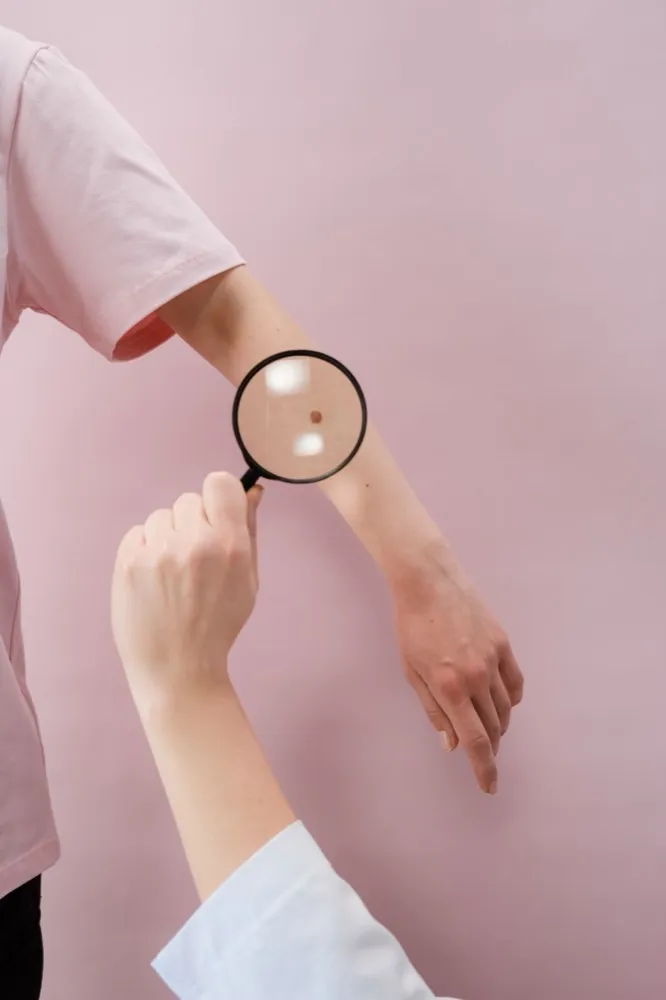
Moles are one of the most common reasons people visit my office — and one of the most important. Most are completely benign and pose no risk. But melanoma — the most dangerous type of skin cancer — usually starts as a mole. Learning to tell when a mole deserves attention can literally save lives.
What is a mole?
A mole (melanocytic nevus) is a cluster of melanocytes — the cells that produce pigment — in the skin. They are extremely common: most adults have between 20 and 40 moles. They appear from childhood and may keep appearing until around age 40.
The vast majority are benign and never turn into cancer. However, the risk exists and is real, especially in people with a personal or family history of melanoma, fair skin, or intense, chronic sun exposure.
The ABCDE rule
This is the most important tool anyone can use to check their own moles at home:
A — Asymmetry
A typical benign mole is symmetrical: if you divide it in half, both halves match. If a mole is asymmetrical (one half different from the other), it should be evaluated.
B — Border
Benign moles have regular, well-defined borders. Irregular, jagged, blurred or "spreading" borders are warning signs.
C — Color
A benign mole has a uniform color (brown, dark brown or black). Several colors within the same mole — lighter, darker, reddish, bluish or whitish areas — are a concern.
D — Diameter
Historically, 6 mm (the size of a pencil eraser) was used as a reference. Today we know melanomas can be smaller. Even so, any mole larger than 6 mm should be evaluated, especially if it also has other suspicious features.
E — Evolution
This may be the most important criterion. A mole that changes — in size, shape or color, or that starts to itch, bleed or crust — should be checked whether or not it meets the other criteria.
When should you see a dermatologist urgently?
See a doctor soon (don't wait for your next routine visit) if a mole:
- Bleeds spontaneously or with minimal friction
- Itches persistently
- Has an area that turns intensely black or loses color (turns white)
- Grows visibly over weeks or a few months
- Gives you the feeling that "something has changed"
Risk factors for melanoma
Some people need to be more vigilant:
- Fair skin, light eyes, blond or red hair (less protective melanin)
- A history of severe sunburns, especially in childhood
- Intense, chronic sun exposure or use of tanning beds
- Many moles (more than 50) or atypical moles (larger, with irregular borders)
- A personal or family history of melanoma
- A weakened immune system (transplant recipients, immunosuppressive treatment)
What is dermoscopy?
Dermoscopy is a technique dermatologists use to examine moles with a polarized-light microscope. It reveals structures that aren't visible to the naked eye and makes it possible to distinguish much more accurately between a benign and a suspicious mole.
A dermoscopic mole check is completely painless and requires no preparation. I recommend it at least once a year for people with risk factors, and every 2 years as a routine check for people without significant risk factors.
What happens if a mole looks suspicious?
If the dermoscopic evaluation shows suspicious features, the next step is a skin biopsy: the mole is removed completely (or partially, depending on the case) under local anesthesia and sent for histopathological analysis. It's an outpatient procedure and the scar is usually minimal.
If the result confirms melanoma, the prognosis depends largely on the stage at diagnosis. Melanomas detected early (in situ or very thin) have cure rates above 95%. Those detected late, when lymph nodes are involved or there is metastasis, are much harder to treat.
Mole removal: when and how?
A mole can be removed for two reasons:
- Medical reasons: when malignancy is suspected or the mole is in an area of constant friction that repeatedly irritates it
- Cosmetic reasons: when the mole is bothersome because of its location or appearance
Removal is done by electrocautery (for superficial moles) or surgical excision (for deeper moles that need analysis). It is always performed under local anesthesia in the office.
Important: never try to remove a mole at home with any product from the internet or home remedy. Besides the risk of infection, you lose the chance to send it for analysis, which is crucial for any mole with even a slightly atypical feature.
Do you have moles you'd like checked? I recommend doing it preventively and regularly. I perform a complete dermoscopic evaluation during the consultation. Book your appointment with Dr. Alejandra Téllez in Bogotá.
